do u like the website ?

Saturday, 6 August 2011

We Invite You To ISLAM


Assalamu ‘alaikum.
Hi and welcome,
This website is dedicated especially to our not-yet-Muslim friends, so that they can learn from their friends’ experience of converting to ISLAM. The compilation of articles and videos in this website is based on their true stories published in various sources of books, magazines, websites etc. I hope this tiny effort can be an opening door for those who are interested in knowing about ISLAM, to unfold further and seek the truth of ISLAM.

I invite you to embrace ISLAM and may ALLAH guide us to the truth, ameen.
“…Verily, the Right Path has become distinct from the wrong path.” (Al-Qur’an 2:256)


VIDEOS ON CONVERT/REVERT TO ISLAM

ARTICLES ON CONVERT/REVERT TO ISLAM

MUHAMMAD ALI the Great BoXeR

-->
1960
October 29 - Tunney Hunsaker, Louisville, KY - W 6
December 27 - Herb Siler, Miami Beach, FL - KO 4
1961
January 17 - Tony Esperti, Miami Beach, FL - KO 3
February 7 - Jim Robinson, Miami Beach, FL - KO 1
February 21 - Donnie Fleeman, Miami Beach, FL - KO 7
April 19 - Lamar Clark, Louisville, KY - KO 2
June 26 - Duke Sabedong, Las Vegas, NV - W 10
July 22 - Alonzo Johnson, Louisville, KY - W 10
October 7 - Alex Miteff, Louisville, KY - KO 6
November 29 - Willi Besmanoff, Louisville, KY - KO 7
1962
February 19 - Sonny Banks, New York, NY - KO 4
March 28 - Don Warner, Miami Beach, FL - KO 4
April 23 - George Logan, Los Angeles, CA - KO 6
May 19 - Billy Daniels, New York, NY - KO 7
July 20 - Alejandro Lavorante, Los Angeles, CA - KO 5
November 15 - Archie Moore, Los Angeles, CA - KO 4
1963
January 24 - Charlie Powell, Pittsburgh, PA - KO 3
March 13 - Doug Jones, New York, NY - W 10
June 18 - Henry Cooper, London - KO 5
1964
February 25 - Sonny Liston, Miami Beach, FL - KO 7
Muhammad Ali wins the Heavyweight Title
1965
May 25 - Sonny Liston, Lewiston, ME - KO 1
November 22 - Floyd Patterson, Las Vegas, NV - KO 12
1966
March 29 - George Chuvalo, Toronto - W 15
May 21 - Henry Cooper, London - KO 6
August 6 - Brian London, London - KO 3
September 10 - Karl Mildenberger, Frankfurt,Germany - KO 12
November 14 - Cleveland Williams, Houston, TX - KO 3
1967
February 6 - Ernie Terrell, Houston, TX - W 15
March 22 - Zora Folley, New York, NY - KO 7
Ali is stripped of his title in April, for refusing the
military draft on religious grounds.
1970
Ali returns to boxing after three-and-a-half year layoff.
October 26 - Jerry Quarry, Atlanta, GA - KO 3
December 7 - Oscar Bonavena, New York, NY - KO 15
1971
March 8 - Joe Frazier, New York, NY - L 15
Ali loses Heavyweight Title match.
It is his 1st loss as a Professional.
Frazier is now the Undisputed Heavyweight Champion.
July 26 - Jimmy Ellis, Houston, TX - KO 12
November 17 - Buster Mathis, Houston, TX - W 12
December 26 - Jurgen Blin, Zurich, Switzerland - KO 7 
1972
April 1 - Mac Foster, Tokyo, Japan - W 15
May 1 - George Chuvalo, Vancouver, Canada - W 12
June 29 - Jerry Quarry, Las Vegas, NV - KO 7
July 19 - Al 'Blue' Lewis, Dublin - KO 11
September 20 - Floyd Patterson, New York, NY - KO 7
November 21 - Bob Foster, Stateline, NV - KO 8
1973
February 14 - Joe Bugner, Las Vegas, NV - W 12
March 31 - Ken Norton, San Diego, CA - L 12
Jaw is broken in 2nd round, but Ali fights 10 more rounds. Loses by decision. Only the 2nd loss of Ali's career.
September 10 - Ken Norton, Los Angeles, CA - W 12
October 20 - Rudi Lubbers, Jakarta, Indonesia - W 12
1974
January 28 - Joe Frazier, New York, NY - W 12
October 30 - George Foreman, Kinshasa, Zaire - KO 8
Muhammad Ali Regains the Heavyweight Title,
becoming only the 2nd Heavyweight to ever do so.
1975
March 24 - Chuck Wepner, Cleveland, OH - KO 15
May 16 - Ron Lyle, Las Vegas, NV - KO 11
June 30 - Joe Bugner, Kuala Lumpur, Malaysia - W 15
October 1 - Joe Frazier, Manila, Phillipines - KO 14
1976
February 20 - Jean Pierre Coopman, San Juan, PR - KO 5
April 30 - Jimmy Young, Landover, MD - W 15
May 24 - Richard Dunn, Munich, Germany - KO 5
September 28 - Ken Norton, New York, NY - W 15
1977
May 16 - Alfredo Evangelista, Landover, MD - W 15
September 29 - Earnie Shavers, New York, NY - W 15
1978
February 15 - Leon Spinks, Las Vegas, NV - L 15
Ali loses the Heavyweight Title by Split-Decision.
3rd Loss of Ali's Career
September 15 - Leon Spinks, New Orleans, LA - W 15
Muhammad Ali wins the Heavyweight Title for the 3rd time,
becoming the first Heavyweight in boxing history to do so.
Muhammad Ali announces his retirement from boxing.
1980
October 2 - Larry Holmes, Las Vegas, NV - L by TKO 11
Ali makes a failed comeback after 2-year layoff and loses
in an attempt to win Title for the 4th time.
1981
December 11 - Trevor Berbick, Nassau, Bahamas - L 10
Ali loses again in a final failed comeback attempt.
MUHAMMAD ALI retires from boxing for good.

Monday, 1 August 2011

Charlie Brown history . . .

Charlie Brown was a famous cartoon character created by Charles M. Schulz. He was the protagonist of the cartoon strip ‘Peanut’, one of the most famous and talked about cartoon strip. Charlie Brown was first casted in 1950 as a kid with no skills. He represented kids without any luck whatsoever, facing failures at all stage of their life. Charlie Brown was a child who was a prey to the comments and mockery of the other casts of the cartoon strips. Though he was always mocked at and was a target for some or the other disappointment, he never used to give up and always tried to prove his stand. There was a common connection between Charlie Brown and his creator - the similarity being that they both were the sons of a barber. The character of Charlie Brown is an example of the great American un-success story, as he used to fail in almost everything he did. This article will provide you with some interesting and amazing information on the origin and background of Charlie Brown.

Interesting & Amazing Information On Origin & Background Of Charlie Brown
Charlie Brown is a comic character of the 20th century American comic strip ‘Peanut’, created by Charles Schulz. ‘Peanut’ was one of the most famous and highly acclaimed newspaper cartoon strip, which first got published on 2nd October, 1952. Charlie Brown represented a youthful character in it. He was a lovable and endearing loser who got humiliated by everyone and was always dominated by the bossy ‘Lucy van Pelt’ and other characters of the cartoon strip. Though having endless determinations and hope, Charlie was always overpowered by his bad luck and was ultimately dominated by several insecurities. He was a kid who realized his failures and the bad luck that he faced.

Charlie Brown is usually considered to be bald, though he had a bit of hair at the front of his head, which is actually an artistic shortcut given to him, representing the frontline of his hair. The back of his head which carried a few strands of hair was known as tote. Charlie Brown looked almost similar in all his casts, except some stylistic differences in Schulz’s art style. He used to wear an unadorned striped t-shirt. The Charlie Brown and the Peanut gang included Charlie’s beagle, ‘Snoopy’ and ‘Woodstock’, a little yellow bird, along with other human characters. These two characters were featured in many animated television specials later on, starting with ‘A Charlie Brown Christmas’, 1965 and the award winning and quite successful, long-running live-action stage musical ‘You’re a Good Man, Charlie Brown’, 1967. Apart from these, they were also featured in several other cartoon strips and films after that.

In the initial strips of Peanut, Charlie Brown was projected as more assertive and playful character, than what he became later on. He used to play tricks on other members of the strip. He was projected as a brat who used to cause headache to adults, though he was not competent in any skills from the beginning. Few of the cartoon strips even had romantic overtones between Charlie and Patty and Violet. In the later strips, Charlie Brown evolved into a ‘Sad Sack’ character, which he is well known as. He used to feel enslaved, as he had to care for snoopy, beset by comments from other casts and characters around him. Coming to the storyline, a common approach used included Charlie being stubborn and refusing to give in even when he had lost everything, or suddenly displaying a skill only to suffer humiliations when he used to lose on what he was just about to win.

Charlie’s life was full of sad and disgraceful happenings and surrounded by his disposition to bad luck. He never used to receive any valentine or Christmas gifts or cards. However, he never lost hope and always tried to prove his stand. His misfortunes granted him the sympathy of his audience and such was his popularity that audience used to send Charlie Brown Valentine and Christmas cards and gifts, in an effort to show that they cared for Charlie Brown. Amidst the uncountable loses, Charlie Brown did have occasional victories though, such as hitting a game winning run off a pitchy by Roy Hobbs’ great granddaughter on March 30, 1993. He even defeated “Joe Agate” in a game of marbles on April 11, 1995. Charlie Brown continued and maintained this deportment until the strip ended in 2000.

Elizabeth Taylor: history of health problems


http://www.youtube.com/watch?v=OFeeuDPz-u8&feature=related


  Taylor was born with the condition and suffered back problems all her life as a result.

"My body's a real mess," she admitted in a 2004 interview, aged 72.

"I've become one of those poor little women who's bent sideways. I feel so stupid and feeble that I can't do the work I was meant to do because of my bloody body."

Accidents also dogged the Hollywood star from her early days.

She broke her foot filming Lassie Come Home as a child, fell from her horse making National Velvet and underwent surgery to save her sight in 1953 after a flint fragment became embedded in her eye on the set of Elephant Walk.

There were dozens of operations for back pain, tonsilitis, appendicitis, kidney problems, bronchial infections, an ovarian cyst, and several broken bones acquired on various skiing holidays and film sets.

She underwent a partial hysterectomy and was admitted to hospital with amoebic dysentery.

In 1961 she almost died after contracting pneumonia and required an emergency tracheotomy, and in 2000 another bout of pneumonia left her clinging to life.

Doctors diagnosed a benign brain tumour in 1997, which was successfully removed.

She was treated for skin cancer in 2002.

In May 2005, after a piece in Vanity Fair noted her long absence from public life, she put on one last show by turning up at Sir Elton John's Oscar-night party.

With huge effort, she got out of her wheelchair and walked up to the cameras.

"I want to make sure that people know I'm still alive," she said.

Taylor was once asked why she had experienced so many brushes with death.

She replied: "I don't know. I have kind of wondered about that once or twice. And I think each time I have learned a lesson from it. Each time that I have almost died, while I have been recuperating and not quite knowing whether I was going to make it or not, you have time, plenty of time.

"Even an hour is plenty of time when you don't know whether you are going to live or not. And you think: Why did I make it? Why am I not dead? Everything indicated that I should be.

"There must be some reason that God wants me to live. There must be something left for me to do. And I have to find out what that something is and go out there and do it."

In May 2009 the star sent a message to her fans on the Twitter website, announcing she was home after a hospital stay. She thanked them "for all the love and support".

Publicist Dick Guttman said that she was admitted "for a routine visit".

 Dame Elizabeth, an avid Twitter user, also sent a tweet asking a friend to get her puppy past hospital security . . .

Walt Disney History . . .

Introduction


(Born December 5, 1901, Chicago, Illinois, U.S.—died December 15, 1966, Los Angeles, California) American motion-picture and television producer and showman, famous as a pioneer of animated cartoon films and as the creator of such cartoon characters as Mickey Mouse and Donald Duck. He also planned and built Disneyland, a huge amusement park that opened near Los Angeles in 1955, and before his death he had begun building a second such park, Walt Disney World, near Orlando, Florida. The Disney Company he founded has become one of the world's largest entertainment conglomerates.
Early life


Walter Elias Disney was the fourth son of Elias Disney, a peripatetic carpenter, farmer, and building contractor, and his wife, Flora Call, who had been a public school teacher. When Walt was little more than an infant, the family moved to a farm near Marceline, Missouri, a typical small Midwestern town, which is said to have furnished the inspiration and model for the Main Street, U.S.A., of Disneyland. There Walt began his schooling and first showed a taste and aptitude for drawing and painting with crayons and watercolours.

His restless father soon abandoned his efforts at farming and moved the family to Kansas City, Missouri, where he bought a morning newspaper route and compelled his young sons to assist him in delivering papers. Walt later said that many of the habits and compulsions of his adult life stemmed from the disciplines and discomforts of helping his father with the paper route. In Kansas City the young Walt began to study cartooning with a correspondence school and later took classes at the Kansas City Art Institute and School of Design.

In 1917 the Disneys moved back to Chicago, and Walt entered McKinley High School, where he took photographs, made drawings for the school paper, and studied cartooning on the side, for he was hopeful of eventually achieving a job as a newspaper cartoonist. His progress was interrupted by World War I, in which he participated as an ambulance driver for the American Red Cross in France and Germany.

Returning to Kansas City in 1919, he found occasional employment as a draftsman and inker in commercial art studios, where he met Ub Iwerks, a young artist whose talents contributed greatly to Walt's early success.

First animated cartoons


Dissatisfied with their progress, Disney and Iwerks started a small studio of their own in 1922 and acquired a secondhand movie camera with which they made one and two-minute animated advertising films for distribution to local movie theatres. They also did a series of animated cartoon sketches called Laugh-O-grams and the pilot film for a series of seven-minute fairy tales that combined both live action and animation, Alice in Cartoonland. A New York film distributor cheated the young producers, and Disney was forced to file for bankruptcy in 1923. He moved to California to pursue a career as a cinematographer, but the surprise success of the first Alice film compelled Disney and his brother Roy—a lifelong business partner—to reopen shop in Hollywood.

With Roy as business manager, Disney resumed the Alice series, persuading Iwerks to join him and assist with the drawing of the cartoons. They invented a character called Oswald the Lucky Rabbit, contracted for distribution of the films at $1,500 each, and propitiously launched their small enterprise. In 1927, just before the transition to sound in motion pictures, Disney and Iwerks experimented with a new character—a cheerful, energetic, and mischievous mouse called Mickey. They had planned two shorts, called Plane Crazy and Gallopin' Gaucho, that were to introduce Mickey Mouse when The Jazz Singer, a motion picture with the popular singer Al Jolson, brought the novelty of sound to the movies. Fully recognizing the possibilities for sound in animated-cartoon films, Disney quickly produced a third Mickey Mouse cartoon equipped with voices and music, entitled Steamboat Willie, and cast aside the other two soundless cartoon films. When it appeared in 1928, Steamboat Willie was a sensation.

The following year Disney started a new series called Silly Symphonies with a picture entitled The Skeleton Dance, in which a skeleton rises from the graveyard and does a grotesque, clattering dance set to music based on classical themes. Original and briskly syncopated, the film ensured popular acclaim for the series, but, with costs mounting because of the more complicated drawing and technical work, Disney's operation was continually in peril.

The growing popularity of Mickey Mouse and his girlfriend, Minnie, however, attested to the public's taste for the fantasy of little creatures with the speech, skills, and personality traits of human beings. (Disney himself provided the voice for Mickey until 1947.) This popularity led to the invention of other animal characters, such as Donald Duck and the dogs Pluto and Goofy. In 1933 Disney produced a short, The Three Little Pigs, which arrived in the midst of the Great Depression and took the country by storm. Its treatment of the fairy tale of the little pig who works hard and builds his house of brick against the huffing and puffing of a threatening wolf suited the need for fortitude in the face of economic disaster, and its song “Who's Afraid of the Big Bad Wolf?”was a happy taunting of adversity. It was in this period of economic hard times in the early 1930s that Disney fully endeared himself and his cartoons to audiences all over the world, and his operation began making money in spite of the Depression.

Disney had by that time gathered a staff of creative young people, who were headed by Iwerks. Colour was introduced in the Academy Award-winning Silly Symphonies film Flowers and Trees (1932), while other animal characters came and went in films such as The Grasshopper and the Ants (1934) and The Tortoise and the Hare (1935). Roy franchised tie-in sales with the cartoons of Mickey Mouse and Donald Duck—watches, dolls, shirts, and tops—and reaped more wealth for the company.
Feature-length cartoons


Walt Disney was never one to rest or stand still. He had long thought of producing feature-length animated films in addition to the shorts. In 1934 he began work on a version of the classic fairy tale Snow White and the Seven Dwarfs (1937), a project that required great organization and coordination of studio talent and a task for which Disney possessed a unique capacity. While he actively engaged in all phases of creation in his films, he functioned chiefly as coordinator and final decision maker rather than as designer and artist. Snow White was widely acclaimed by critics and audiences alike as an amusing and sentimental romance. By animating substantially human figures in the characters of Snow White, the Prince, and the Wicked Queen and by forming caricatures of human figures in the seven dwarfs, Disney departed from the scope and techniques of the shorts and thus proved animation's effectiveness as a vehicle for feature-length stories.

While Disney continued to do short films presenting the anthropomorphic characters of his little animals, he was henceforth to develop a wide variety of full-length entertainment films, such as Pinocchio (1940), Dumbo (1941), and Bambi (1942). Disney also produced a totally unusual and exciting film—his multisegmented and stylized Fantasia (1940), in which cartoon figures and colour patterns were animated to the music of Igor Stravinsky, Paul Dukas, Pyotr Ilyich Tchaikovsky, and others. In 1940 Disney moved his company into a new studio in Burbank, California, abandoning the old plant it had occupied in the early days of growth.

Major films and television productions


A strike by Disney animators in 1941was a major setback for the company. Many top animators resigned, and it would be many years before the company produced animated features that lived up to the quality of its early 1940s classics. Disney's foray into films for the federal government during World War II helped the studio perfect methods of combining live-action and animation; the studio's commercial films using this hybrid technique include The Reluctant Dragon (1941), Saludos Amigos (1942), The Three Caballeros (1945), Make Mine Music (1946), and Song of the South (1946).

The Disney studio by that time was established as a big-business enterprise and began to produce a variety of entertainment films. One popular series, called True-Life Adventures, featured nature-based motion pictures such as Seal Island (1948), Beaver Valley (1950), and The Living Desert (1953). The Disney studio also began making full-length animation romances, such as Cinderella (1950), Alice in Wonderland (1951), and Peter Pan (1953), and produced low-budget, live-action films, including The Absent-Minded Professor (1961).

The Disney studio was among the first to foresee the potential of television as a popular entertainment medium and to produce programs directly for it. The Zorro and Davy Crockett series were very popular with children, and a weekly showcase (known by several titles, including Walt Disney's Wonderful World of Color) became a Sunday night fixture. The Mickey Mouse Club, a variety show featuring a cast of teenage performers known as the Mouseketeers, was also successful. The climax of Disney's career as a producer, however, came with his release in 1964 of the motion picture Mary Poppins, which won worldwide popularity.
Disneyland


In the early 1950s Disney had initiated plans for a huge amusement park to be built near Los Angeles. When Disneyland opened in 1955, much of Disney's disposition toward nostalgic sentiment and fantasy was evident in its design and construction. It soon became a mecca for tourists from around the world. A second Disney park, Walt Disney World, near Orlando, Florida, which was under construction at the time of his death, opened in 1971.

Assessment


Disney's imagination and energy, his whimsical humour, and his gift for being attuned to the vagaries of popular taste inspired him to develop well-loved amusements for “children of all ages” throughout the world. Although some criticized his frequently saccharine subject matter and accused him of creating a virtual stylistic monopoly in American animation that discouraged experimentation, there is no denying his pathbreaking accomplishments. His achievement as a creator of entertainment for an almost unlimited public and as a highly ingenious merchandiser of his wares can rightly be compared to the most successful industrialists in history . . . 

Sunday, 31 July 2011

A.Q. Khan Nuclear Chronology


he complete extent of Pakistani scientist Abdul Qadeer Khan’s decades-long involvement in
the illegal transfer of nuclear materials and technologies is not known.  The details are
submerged in Khan’s work over the past thirty years, which has included both the development
of Pakistan’s uranium enrichment capabilities and a complex international network of experts,
suppliers, and front companies that have aided Iran, Libya, North Korea, and potentially others.
Since we do not know exactly what Khan did, we cannot know when he did it.  As more
information is released from those who have questioned Khan and his network partners, a more
complete image of the nuclear black market will emerge. This chronology summarizes what we
now know.
Khan Builds His Base in Pakistan
Pre-1985: Khan’s early exposure to European technology and supply chains allow him to establish and develop
uranium enrichment technologies in Pakistan.  Knowledge of the technologies, and more importantly, the companies
from which to obtain the necessary components set the foundation for how the future proliferation network would
operate.
1936
• Khan is born in Bhopal, which is part of British India.  Khan will immigrate with his
family to Pakistan in 1952, several years after India and Pakistan are partitioned.
1961
• Khan moves to Europe to complete his studies, first in West Berlin and later at the
Technical University in Delft, Holland, where he receives a degree in metallurgical
engineering in 1967.
1
1972
• Khan receives Ph.D. in metallurgical engineering from the Catholic University of Leuven
in Belgium.
• May – Khan begins work at Physical Dynamic Research Laboratory (FDO), a
subcontractor of Ultra Centrifuge Nederland (UCN).  UCN is the Dutch partner in the
Urenco uranium enrichment consortium.
2
• 8 May - Within one week of starting work at FDO, Khan visits the advanced UCN
enrichment facility in Almelo, Netherlands to become familiar with Urenco centrifuge
operations and the aspects relevant to his own work to strengthen the metal centrifuge
T2
components.  Khan is not officially cleared to visit the facility, but does so many times
with the consent of his employers.
3
Early 1970s
• Dutch intelligence begins to monitor Khan soon after he begins work at FDO, concerned
by a series of inquiries about technical information not related to Khan’s own projects.
4
1974
• 18 May – India conducts its first nuclear test, a “peaceful nuclear explosion.”
5
• September – Khan writes to Prime Minister Zulfikar Ali Bhutto to offer his services and
expertise to Pakistan.
6
• Late – Khan is tasked by UCN at Almelo with translations of the more advanced
German-designed G-1 and G-2 centrifuges from German to Dutch, to which he has
unsupervised access for 16 days.
7
Late 1970s and Early 1980s
• American intelligence officials convince Dutch authorities on two occasions not to arrest
Khan for the purposes of monitoring his activities further.
8
1975
• August – Pakistan begins buying components for its domestic uranium enrichment
program from European Urenco suppliers.  S.A. Butt, a physicist in the Pakistani
embassy in Belgium, contacts a Dutch company to obtain high frequency inverters, which
are used to control centrifuge motors.  Purchases accelerate in the following years and
many components are secured from companies in the Netherlands that Khan is familiar
with.
9
• October – Khan is transferred away from enrichment work with FDO as Dutch
authorities become increasingly concerned over his activities.  He is reportedly observed
asking “suspicious questions” at a nuclear trade show in Switzerland.
10
• 15 December – Khan suddenly leaves FDO for Pakistan with copied blueprints for
centrifuges and other components and contact information for nearly 100 companies that
supply centrifuge components and materials.
11
1976
• Khan begins centrifuge work with the Pakistan Atomic Energy Commission (PAEC),
headed by Munir Ahmad Khan.
• July – After conflicts at the PAEC, Prime Minister Bhutto gives Khan autonomous
control over Pakistani uranium enrichment programs.
12
  Khan founds Engineering
Research Laboratory (ERL) on July 31, which focuses exclusively on developing an
indigenous uranium enrichment capability.
13
• The PAEC continues nuclear research and experiments in both weapons and power
programs in competition with A.Q. Khan and will later develop Pakistan’s first generation
of nuclear weapons.
143
1978
• ERL develops working prototypes of P-1 centrifuges, adapted from the German G-1
design Khan worked with at Urenco.  Pakistan enriches uranium for the first time on
April 4 at Khan’s enrichment facility at Kahuta.
15
1979
• April - Pakistan is cut off from economic and military assistance by the United States
after U.S. intelligence learns of the recently commissioned enrichment facility at Kahuta.
16
 
However, the strategic importance of Pakistan after the Soviet invasion of Afghanistan
ensures that no meaningful sanctions will be imposed.  This policy is consolidated
following the election of Ronald Reagan in 1980.
17
Early 1980s
• Khan acquires blueprints for the Chinese bomb that was tested in China’s fourth nuclear
explosion in 1966.
18
• Khan is, reportedly, approached by an unknown Arab country (possibly Saudi Arabia or
Syria) requesting nuclear assistance.
19
1981
• 1 May – ERL is renamed A.Q. Khan Research Laboratories (KRL) by President Zia ulHaq in recognition of Khan’s contributions to the operational enrichment facility at
Kahuta.
20
1983
• Khan is convicted, in absentia, in Dutch court for conducting nuclear espionage and
sentenced to four years in prison.
21
1985
• Khan’s conviction is overturned based on an appeal that he had not received a proper
summons.  The Dutch prosecution does not renew charges because of the impossibility
of serving Khan a summons given Pakistan security and the inability to obtain any of the
documents that Khan had taken to Pakistan.
22
The Network Flows Both Ways
Mid-1980s to mid-1990s: Khan’s early successes with the Pakistani uranium enrichment program are followed by
the more advanced design and technologies of the P-2 centrifuge, an adapted version of the German G-2 that can
spin twice as fast as the previous P-1 design.  Khan is left with an excess inventory of P-1 components and begins
to purchase additional P-2 components that he will export through many of the same channels he had used to
import centrifuge components.  Khan makes nuclear sales in this period to Iran and offers technologies to Iraq and
possibly others.
Mid 1980s
• Pakistan produces enough highly enriched uranium (HEU) for a nuclear weapon.  KRL
continues work on enrichment and is tasked with research and development of missile
delivery systems.
234
• Khan, reportedly, begins to develop his export network and orders twice the number of
components necessary for the indigenous Pakistani program.  This transition from
importer to exporter of centrifuge components is, apparently, completely missed by
western intelligence services who believe Khan is only working on Pakistan’s domestic
nuclear weapons program.
24
1986 to 1987
• Pakistan and Iran are suspected of signing a secret agreement on peaceful nuclear
cooperation.  Allegedly, the deal includes a provision for at least six Iranians to be trained
in Pakistan at the Institute of Nuclear Science and Technology in Islamabad and the
Nuclear Studies Institute.  Iranian scientists might also receive centrifuge training at
KRL.
25
• Khan is suspected of visiting the Iranian reactor at Bushehr in February 1986 and again in
January 1987.  These early interactions may have led directly to Khan’s assistance to Iran,
but the content of the visits is unknown.
26
Late 1980s
• Khan and his network of international suppliers are reported to begin nuclear transfers to
Iran.  The period of cooperation is thought to continue through 1995 when P-2
centrifuge components are transferred.  The Pakistani government claims no transfers
occurred after the shipments of P-1 components and sub-assemblies from 1989 to 1991.
27
• German intelligence investigates potential Pakistani assistance to Iraq, and possibly Iran
and North Korea, with processes related to melting uranium.
28
1987
• Khan is suspected of having made an offer to Iran to provide a package of nuclear
technologies, including assistance for the difficult process of casting uranium metal.  The
price for the package is reported to be from the tens of millions to the hundreds of
millions.
29
• Khan is believed to make a centrifuge deal with Iran to help build a cascade of 50,000 P-1
centrifuges.
30
  In addition, Iran may have received centrifuge drawings through an
unknown foreign intermediary around this time.
31
• KRL begins to publish publicly available technical papers that outline some of the more
advanced design features Khan has developed.  The papers include information that
would normally be classified in the U.S. and Europe and show that KRL is competent in
many aspects of centrifuge design and operation.  The papers also include specifications
for centrifuges with maraging steel that can spin faster than earlier aluminum designs.
Later, in 1991, KRL publishes details on how to etch grooves around the bottom bearing
to incorporate lubricants.  These technical developments are important for Khan’s P-2
centrifuges.
32
1988
• Iranian scientists are suspected of having received nuclear training in Pakistan.
335
1989
• Iran is suspected of receiving its first centrifuge assemblies and components around this
time.  The shipped components are likely older P-1 centrifuge components that Khan no
longer has use for in Pakistan.  Through 1995, Khan is reported to have shipped over
2000 components and sub-assemblies for P-1, and later P-2, centrifuges to Iran.
34
1990
• An Iraqi memo, found during inspections in 1995, indicates that Khan may have offered
significant nuclear assistance to Iraq in late 1990.  He offered to sell Iraq a nuclear bomb
design and guarantee material support from Western Europe for a uranium enrichment
program.   Khan stated that any materials needed from Europe could be routed through a
company he owned in Dubai and that a meeting with a friendly intermediary could take
place in Greece.  However, Iraq is believed to have turned down the offer, suspecting it
to be a sting and no known follow-ups were made after the 1991 Gulf War.  The
investigation in the 1990s was inconclusive in its efforts to determine the authenticity of
the memo.
35
1992
• Pakistan begins missile cooperation with North Korea.  Within Pakistan, KRL is one of
the laboratories responsible for missile research and will develop the Ghauri missile with
North Korean assistance.  This cooperation probably establishes the connections that
Khan could have used to transfer nuclear technologies.  However, very little is known
about when any nuclear transfers began, what nuclear components might have been
obtained by North Korea, and whether or not the Pakistani government was privy to
Khan’s activities.
36
1994 or 1995
• More advanced components for P-2 centrifuges are suspected to have arrived in Iran.
B.S.A. Tahir, a Sri Lankan business man and Khan’s chief lieutenant, told Malaysian
police that Iran paid approximately $3 million for these centrifuge parts.
37
The Network Expands
Mid-1990s to the Present: After initial nuclear transfers to Iran, A.Q. Khan appears to have expanded his
network of customers to include Libya and North Korea.  Khan’s network was based on a complex structure of
international suppliers that shipped components unimpeded by ineffective controls.  Details of Libya’s acquisition
trace the network to Malaysia, Singapore, Turkey, South Africa, Switzerland, South Korea, Dubai, and possibly
others.
38
  Khan appears to have been financially motivated and, reportedly, received over $100 million from sales to
39
Libya alone
  Many details of the sales to Libya have been uncovered since late 2003, when it decided to come
clean about its nuclear program.  However many aspects of the network remain mysterious, including network
sources for some necessary centrifuge components and details about suspected transfers to  North Korea.
Mid 1990s
• Khan starts travel to North Korea where he receives technical assistance for the
development of the Ghauri missile, an adaptation of the North Korean No Dong design.
Khan makes at least 13 visits before his public confession in 2004 and is suspected of
arranging a barter deal to exchange nuclear and missile technologies, though the details of 6
any nuclear transfers remain unknown.  Khan travels with military personnel from KRL.
These officials could have helped with the transfer of nuclear technology because
programs under the Ministry of Defense were exempt from normal export controls.
40
 
The military presence at KRL, including personnel who traveled to North Korea,
suggests that the Pakistani government might have been aware of Khan’s activities.
President Musharraf denies this claim.
41
• Khan is suspected to have met with a top Syrian official in Beirut to offer assistance with
a centrifuge enrichment facility.
42
1996
• The Pakistani currency reserve crunch may motivate Khan to expand his nuclear network
with sales to North Korea.  The crisis might have made a barter agreement attractive to
Pakistan to avoid defaulting on external debt.  Visits of North Korean and Pakistani
officials accelerate following the crisis, but it is not known if these meetings include
discussions of nuclear transfers or deal exclusively with missile technologies.
43
1997
• Khan begins to transfer centrifuges and centrifuge components to Libya.  Libya receives
20 assembled P-1 centrifuges and components for 200 additional units for a pilot
enrichment facility.  Khan’s network will continue to supply with centrifuge components
until late 2003.
44
• Khan is suspected of beginning nuclear transfers to North Korea around this time,
though the dates of the first transfers are highly uncertain.
45
  Transfers to North Korea
are believed to have continued through 2003, but the Pakistani government claims these
transfers ceased in 2001.  Over this period, Khan may have supplied North Korea with
old and discarded centrifuge and enrichment machines together with sets of drawings,
sketches, technical data, and depleted uranium hexafluoride.
46
 
• December – Several reports state that Pakistan's then-Chief of Army Staff General
Jehangir Karamat secretly visited Pyongyang.
47
 Khan has claimed that Karamat was aware
of the deal between Pakistan and North Korea to exchange enrichment assistance for
missile technologies.
48
 Karamat, now Pakistan's Ambassador to the United States, says
that this information is incorrect. He says that he never visited North Korea and did not
have any knowledge of the proliferation activity.
1998
• India detonates a total of five devices in nuclear tests on May 11 and 13.
• Pakistan responds with six nuclear tests on May 28 and 30.
49
1999
• Pakistani government releases an advertisement of procedures for the export of nuclear
equipment and components.  The ad lists equipment for sale, including gas centrifuges
and magnet baffles for enriching uranium.
50
  Other advertisements from KRL are
reported to include an “unsubtle drawing” of a mushroom cloud and vacuum devices that
attach to centrifuge casings.
51
2000 7
• June – Peter Griffin sets up Gulf Technical Industries in Dubai, which serves as a front
company for Khan’s network.  B.S.A. Tahir will use Gulf Technical Industries as one of
his front companies to order centrifuge components from Malaysia.
52
• September – Libya receives two P-2 centrifuges as demonstrator models and places an
order for components for 10,000 more to build a cascade.  Each centrifuge contains
around 100 parts, implying approximately 1 million parts total for the entire P-2
centrifuge cascade.
53
2001
• Libya obtains 1.87 tons of uranium hexafluoride, the gas that is used to feed enrichment
centrifuges.  The amount is consistent with that required for a small pilot enrichment
facility.
54
  The source of the uranium hexafluoride remains uncertain.  In 2004, evidence
emerges that North Korea might have supplied Libya with the material, which would be
the first discovered transfer of nuclear material from North Korea to an A.Q. Khan
network recipient.  The evidence remains inconclusive, however, and authorities continue
to suspect that the uranium hexafluoride came from Pakistan.
55
• March – Khan is forced into retirement.  Khan refuses the compensatory position of
“advisor to the chief executive” and is later given the ceremonial title of “Special Advisor
to the Chief Executive on Strategic and KRL Affairs.”  However, neither Khan nor the
press use this title.
56
  President Musharraf has admitted that Khan’s suspected
proliferation activity was a critical factor in his removal from KRL.
57
• Summer – American spy satellites detect missile components being loaded into a
Pakistani cargo plane outside of Pyongyang.  Intelligence services assume the cargo to be
missile technology traded in direct exchange for nuclear technology, but no hard evidence
exists.
58
• December – B.S.A. Tahir signs a $13 million contract with Scuomi Precision Engineering
(SCOPE) in Malaysia for 25,000 aluminum centrifuge components.  The components will
be shipped to front companies in Dubai, including Gulf Technical Industries and SMB
Computers.  SCOPE representatives later acknowledge manufacturing parts for Tahir,
but believed that they would be used in Dubai oil and gas industries.
59
Late 2001 or Early 2002
• Libya receives blueprints for nuclear weapons plans.  The plans are reported to be of
Chinese origin with Chinese notes in the margins.
60
  There is reported to be a note on the
blueprints that “Munir’s bomb would be bigger,” possibly a reference to Munir Ahmad
Khan of the PAEC, who was in competition with A.Q. Khan to develop a Pakistani
bomb.
61
2002
• December – Shipments begin from SCOPE of aluminum centrifuge components.  Four
shipments are believed to have been sent from Malaysia to Dubai before August 2003, en
route to Libya.
62
20038
• Spring – The State Department announces some sanctions against KRL, citing illegal
missile transactions.  The State Department also states that it has insufficient evidence to
issue sanctions for illegal nuclear transactions.
63
• April – German authorities intercept a ship in the Suez Canal with a large cargo of strong
aluminum tubing en route to North Korea.  The tube specifications suggest that they are
intended for use as outer casings for P-2 centrifuges.
64
• October – The German cargo ship BBC China is intercepted en route to Libya with
components for 1,000 centrifuges.  The parts were manufactured in Malaysia by SCOPE
and shipped through Dubai.
65
• December – Libya renounces its nuclear weapons program and begins the process of full
disclosure to the IAEA, including the declaration of all foreign procurements.
66
2004
• 4 February – Khan makes a public confession on Pakistani television (in English) of his
illegal nuclear dealings.  Khan claims that he initiated the transfers and cites an “error of
judgment.”  He is pardoned soon after by President Musharraf and has been under house
arrest since.  The Pakistani government claims that Khan acted independently and
without state knowledge.
67
• March – A container aboard the BBC China (the ship that was previously intercepted)
arrives in Libya with one additional container of P-2 centrifuge components.  Colonel
Qaddafi reports the arrival to American intelligence and the IAEA.  The Libyans warn
American officials that not all of the components from Libya’s orders had arrived and
some might still show up in the future.
6

Saturday, 30 July 2011

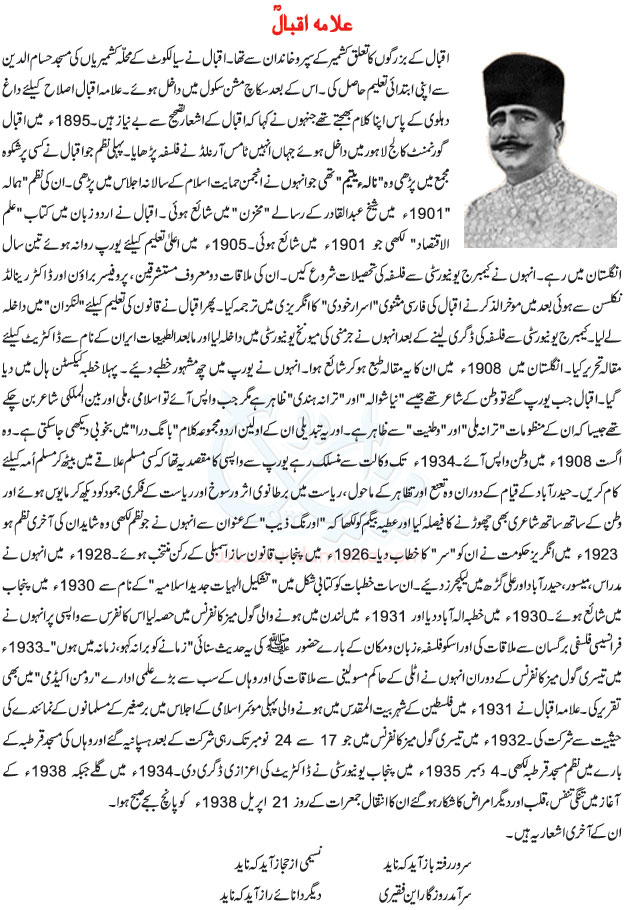
BRIEF LIFE SKETCH of Allama Iqbal


Pattern

BRIEF LIFE SKETCH
Muhammad Iqbal (1877-1938) is one of the preeminent writers of the Indo-Pakistan subcontinent. Indeed, the attention he has received from numerous writers, translators, and critics from Western as well as Islamic countries testifies to his stature as a world literary figure. While his primary reputation is that of a poet, Iqbal has not lacked admirers for his philosophical thought. He has in fact been called “the most serious Muslim philosophical thinker of modem times.” The frequently used appellation of “poet-philosopher” is thus well deserved. The hyphen in the phrase is all-important: Iqbal’s poetry and philosophy do not exist in isolation from each other; they are integrally related, his poetry serving as a vehicle for his thought. Iqbal wrote poetry in Urdu and Persian, and several collections in each language exist. In the following page a life-sketch of Iqbal is followed by a brief treatment of some of the major themes and literary features of his poetry.
*****
Iqbal was born in Sialkot, in the present-day province of the Punjab in Pakistan, in 1877. He received his early education in that city, where one of his teachers was Mir Hasan, an accomplished scholar who commanded a knowledge of several Islamic languages. Mir Hasan gave Iqbal a thorough training in the rich Islamic literary tradition. His influence on Iqbal was formative. Many years later (1922), when the English governor of the Punjab proposed to the British Crown that Iqbal be knighted in acknowledgment of his literary accomplishments, Iqbal asked that Mir Hasan also be awarded a title. To the governor’s remark that Mir Hasan had not authored any books, Iqbal responded that he, Iqbal, was the book Mir Hasan had produced. Mir Hasan received the title of Shams al-’Ulama’ (“Sun of Scholars”).
For higher education Iqbal went to Lahore (1895), where he enrolled in Government College, getting, in 1899, an MA in philosophy; he had already obtained a degree in law (1898). In Lahore, a major center of academic and literary activity, Iqbal soon made a name for himself as a poet. One of the teachers of Government College Iqbal admired most was Sir Thomas Arnold. Arnold, too, had great affection for Iqbal, he helped Iqbal in his career as a teacher and also encouraged him to undertake several research projects. When Arnold returned to England in 1904, Iqbal wrote a touching poem in which he expressed his resolve to follow Arnold to England. The very next year, in fact, Iqbal left for study at Cambridge. His choice of Cambridge was probably dictated by the fact that Cambridge was reputed for the study not only of European philosophy but also of Arabic and Persian. In his three years of stay abroad, Iqbal obtained a BA from Cambridge (1906), qualified as a barrister at London’s Middle Temple (1906), and earned a PhD from Munich University (1908).
After returning to Lahore in 1908, Iqbal taught philosophy at Government College for a few years. In 1911 he resigned from government service and set up legal practice. Meanwhile he continued to write poetry in Urdu and Persian, Asrar-i Khudi (Persian) was published in 1915. Translated into English as The Secrets of the Self (1920) by Professor Reynold Nicholson of Cambridge, the book introduced Iqbal to the West. Asrar-i Khudi was followed by several other volumes: Rumuz-i Bikhudi (1918), Payam-i Mashriq (1923), Bang-i Dara (1924), Zabur-i ‘Ajam (1927), Javid Namah(1932), Musafir (1936), Zarb-i Kalim (1937), and Armaghan-i Hijaz (1938, posthumously). Iqbal wrote prose also. His doctoral thesis, The Development of Metaphysics in Persia, was published in 1908, and hisReconstruction of Religious Thought in Islam (with a 7th chapter added to the original set of six lectures, first published in 1930), in 1934. Many of Iqbal’s poetical works have been rendered into foreign languages, including English, German, Italian, Russian, Czechoslovakian, Arabic, and Turkish. His works have also spawned a vast amount of critical literature in many languages.
Although his main interests were scholarly, Iqbal was not unconcerned with the political situation of the, country and the political fortunes of the Muslim community of India. Already in 1908, while in England, he had been chosen as a member of the executive council of the newly established British branch of the Indian Muslim League. In 1931 and 1932 he represented the Muslims of India in the Round Table Conferences held in England to discuss the issue of the political future of India. And in a 1930 lecture Iqbal suggested the creation of a separate homeland for the Muslims of India. Iqbal died (1938) before the creation of Pakistan (1947), but it was his teaching that “spiritually ... has been the chief force behind the creation of Pakistan.” He is the national poet of Pakistan.

II

A detailed discussion of the thematic and literary features of Iqbal’s poetry is not be undertaken here. A few general points may, however, be made.
A reader of Iqbal’s poetry is struck by its sheer thematic variety. Iqbal was deeply interested in the issues that have exercised the best minds of the human race—the issues of the meaning of life, change and constancy, freedom and determinism, survival and progress, the relation between the body and the soul, the conflict between reason and emotion, evil and suffering, the position and role of human beings in the universe—and in his poetry he deals with these and other issues. He had also read widely in history, philosophy, literature, mysticism, and politics, and, again, his catholic interests are reflected in his poetry.
Iqbal celebrates humanity, in more than one sense. On one level he shows broad acceptance for humanity. In “The Story of Adam”, the protagonist, Adam, plays a variety of roles-those of prophet, thinker, reformer, scientist, inventor, astronomer, martyr, and iconoclast. Adam in this poem is not simply a religious figure belonging to a certain tradition, but represents the whole of humankind. On another level, Iqbal takes pride in being human and has no desire to partake of the godhead of God. To be God is to have concerns and worries that would give one a headache, but to be human is to have that sweet pain called heartache. Humans can hold their heads high in view of their achievements in the world to which they were banished from paradise: if God has made the night, then humans have made the lamp, and if God has made deserts and mountains, then humans have made parks and meadows (“A Dialogue Between God and Man,”). Humans must, therefore, strive to be perfect qua humans, and that is a goal yet to be achieved.
The theme of humanity is closely linked in Iqbal with that of khudi(literally, “selfhood”). Khudi is a complex thought in Iqbal. Broadly speaking, it represents the principle of the inner self with an urge to manifest itself Societies as well as individuals have khudi, and it is on the development or suppression of one’s or failure in the world depends,khudi that one’s success   the khudi of slaves, for example, is moribund.
Recognition, discovery, cultivation, and assertion of their khudi should, therefore, be the aim of humans. Iqbal’s critique of Muslim societies is predicated on the assumption that these societies have lost their khudi or have allowed it to become seriously impaired. The best way to understand Iqbal’s concept of khudi is by reading poems in which he discusses the subject.
Perfection, or rather limitless perfection, is a frequently occurring motif in Iqbal’s poetry. “I seek the end of that which has no end,” says Iqbal in “The Houri and the Poet”, and, in the same poem: “From the spark I seek a star, from the star a sun.” Iqbal sees no end to human potentialities. He wishes humans to embark on a never-ending journey of discovery, and to this end emphasizes the importance of action. Constant action and perpetual movement are in fact the only guarantee of survival in the world. Nations fall behind when they cease to be dynamic and start preferring a life of idle speculation over one of purposive action.
But the quest for perfection can give rise to irony. Irony, in fact, fills human life, for while they have been imbued with the desire to achieve perfection, humans have been denied the ability to achieve it in practice. The poems “Man”, “Solitude”, and “The Dew and the Stars” discuss several aspects of the irony of human life. The poem, “The Story of Adam,” though it ends on a more optimistic note, yet implies that it takes humans a long time to discover the most important secret of existence.
“The heart has its reasons, of which reason is ignorant,” says Pascal. Iqbal, who frequently speaks of the conflict of the head and the heart, would agree, though he would add that while the conflict exists, it does not have to. More often than not it is reason (or the intellect) that belittles the heart (or intuition), but both are essential to a harmonious life; ideally, then, reason and the heart should cooperate rather than clash.
Although he has wide-ranging interests, Iqbal essentially belongs to, and speaks from within, the Islamic tradition, employing, for his purposes, the historical, religious, philosophical, and literary resources of that tradition. A full appreciation of Iqbal requires an understanding of these resources, and the notes and commentaries in this volume elucidate Iqbal’s use of them.
Iqbal held to the doctrine of art for life’s sake. Acutely aware of the problems of Muslim decadence and backwardness, Iqbal takes it upon himself to shake the Muslims of India and other countries out of their lethargy, urging them to take the path of progress, so that they can gain an honorable position in the polity of nations, He uses the medium of poetry to arouse socio-religious consciousness among Muslims. As a result, Islamic religious and social themes predominate in his poetry. But Iqbal’s vision of a revived religion is far from conservative. He is sharply critical of many of the institutions of historic Islam (of the institution of monarchy, for example), and his vision of a new world derives from the Islamic notions of egalitarianism and social justice. He rejects dogmatism in religion, advocates rethinking of the Islamic intellectual heritage, and stands for the establishment of a forward-looking community. But the conviction of art for life’s sake never allows Iqbal’s poetry to degenerate into bland or crass propaganda. The worldwide acclamation he has won is proof that Iqbal’s strength consists in writing purpose poetry of the highest artistic standards.
Ultimately, however, the secret of the appeal of Iqbal’s poetry lies in the personality behind that poetry. Whether he is dealing with a broadly humanistic or a specifically Islamic theme, Iqbal views it from a unique perspective. Consider his boldly critical attitude toward certain aspects of the received tradition, an attitude reflected, for example, in the poems referred above. Unlike almost any other poet in the Islamic tradition, Iqbal enters into a dialogue with God, raising issues the orthodox would consider disturbing. He asks whether Adam’s expulsion from heaven has turned out to be Adam’s loss or God’s own; he challenges God to speak to him face to face rather than through messengers, and, noting the discrepancy between the boundlessness of human ambition and the limitedness of the resources put at humans’ disposal, he asks God whether His experiment involving Adam is to be taken seriously. Iqbal’s view of the role of Satan in the world is also highly intriguing and, as one would expect, highly unconventional (see “Conquest of Nature” and “Gabriel and Iblis”).
A notable thing about Iqbal’s perspective is ambiguity, a typical modem quality. Especially when he is talking about metaphysical issues, Iqbal raises some difficult questions, without providing a single “valid” answer. In “Paradise Lost and Regained” the question whether Adam should have sinned or not (each scenario being theoretically defensible) is not answered by Iqbal. In “Gabriel and Iblis” we are left to wonder about Iqbal’s own view of Iblis’ self-justification. And in “Solitude” we cannot be certain why God smiles.
In several places Iqbal talks about himself about his Eastern background and Western education, and the contradictions of his own personality; his conviction that his study of historic Islam had furnished him with certain valuable insights which he must share with his people; his hope that his message will spread across the Muslim world, and his apprehension that he will be misunderstood or appreciated for the wrong reasons. Here it may be added that the various attempts made to identify (or label) Iqbal as a Sufi or an orthodox Muslim, as a radical or a reactionary are wide of the mark because Iqbal is too large a figure to fit any narrow, procrustean category; he demands and deserves attention on his own terms.
Add caption

III

Iqbal had a fine sense of the dramatic, and in his poetry he frequently employs dramatic techniques. Many of his poems are structured like a play, with the first half of the poem building a tension or conflict that is resolved, or raising a question that is answered, in the second half Examples are “Gabriel and Iblis”, “The Dew and the Stars”, “The Houri and the Poet” and “Fatimah bint ‘Abdullah”. Many poems are dialogues, with well-argued positions taken by the interlocutors (“A Dialogue Between God and Man”, “The Dew and the Stars”, “Reason and Heart” and “A Dialogue Between Knowledge and Love”; also the fables). Some poems are one-sided dialogues or monologues (“Give Me Another Adversary”, “The Falcon’s Advice to Its Youngster”). Again, Iqbal carefully weaves the “plot” of a poem, arousing the reader’s curiosity, dropping seemingly casual hints that turn out to be prophetic, providing flashback, and saving his masterstroke for the end. Two excellent examples are “The Night and the Poet” and “The Houri and the Poet”.
Iqbal has some favorite images and motifs. The eagle is Iqbal’s favorite bird, and the tulip his favorite flower. We will here say a few words about the tulip. The tulip is a pretty flower, but, when it grows in the desert (Lala’-i sahra’), it combines strength with beauty, for it then represents the assertion of one’s self (khudi) in the face of hostile circumstances. The tulip owes its splendor not to an outside source but to the “scar” inside its heart, its glow being indigenous to it, as befits a flower with akhudi of its own. The tulip is thus a “model” for individuals and nations to follow. In one of his quatrains (“Freedom and Determinism and Philosophy of History”), speaking of the difficult circumstances that alone give birth to new nations, Iqbal says: “From mountains and deserts do nations arise.” Although Iqbal does not mention the tulip in this quatrain, it would not be far-fetched to suggest that, conceptually, Iqbal here has the desert tulip in mind. The cup-shaped flower suggests to Iqbal’s mind several analogies, and in one piece (“Locke, Kant, and Bergson,”) Iqbal, makes consistent use of the tulip image to describe and analyze complex philosophical ideas. It is in view of the deep significance of the flower in Iqbal’s poetry that I have chosen Tulip in the Desert as the title of my volume of translations (Mustansir Mir, Tulip in the Desert,Hurst and Company, London, 2000). The images of the eagle and the tulip illustrate how Iqbal adds to the native literary tradition or makes an innovative use of that tradition (the tulip). Another example in this connection is that of the moth. In Persian and Urdu poetry the moth represents the devoted and self-immolating lover. Like the moth, which keeps circling the light, the lover (a male) desires to stay close to the beloved (a female). But in Iqbal, typically, the moth often represent a reprehensible rather than a praiseworthy quality: the shining light it is in love with is not its own. The moth is to be contrasted with another, the firefly, which, though it has a weak light, can at least call this light its own. The firefly, in other words, is possessed of khudi, but the moth has no khudi. Iqbal often uses a series of images to convey a thought, producing a cumulative effect. In “Fatimah bint -Abdullah,” for example, he uses no fewer than four images to express the idea that, even in its present age of decadence, the Muslim Community can produce individuals of exceptional caliber:

O that our autumn-stricken garden had 

A flower-bud like this! 
O that in our ashes would be found, O Lord, 
A spark like this! 
In our desert is hidden many a deer still. 
In the spent clouds lies dormant still 
Many a flash of lightning.